1. Mô tả chỉ báo Lorentzian Harmonic Flow (⚡LHF)
Công cụ phân tích thị trường dựa trên lý thuyết thời gian cong và bộ nhớ lịch sử
1.1 Concept của chỉ báo
LHF (Lorentzian Harmonic Flow) tin rằng: thời gian thị trường không chạy đều như kim đồng hồ. Khi thị trường biến động mạnh, thời gian bị "nén lại" — một tuần diễn biến có thể xảy ra chỉ trong vài phút. Khi thị trường đi ngang, thời gian "giãn ra" — giá dao động mà không có xu hướng rõ ràng.
LHF áp dụng công thức Lorentz từ thuyết tương đối Einstein để tính hệ số gamma (γ) — đại diện cho mức độ nén/giãn thời gian:
• v (velocity): Vận tốc xu hướng — đo bằng khoảng cách giá di chuyển trong N nến, chuẩn hóa bởi ATR
• c (speed of market): "Tốc độ giới hạn" của thị trường — tính từ độ biến động thực tế (realized volatility) + độ bùng nổ đột ngột (burst)
• γ: Khi γ ≈ 1 → thời gian bình thường; γ > 2 → thời gian bị nén, cần dùng khung ngắn hơn để nắm bắt thông tin
Nguyên lý cốt lõi: Chỉ báo tin rằng thị trường có "nhịp điệu riêng" (harmonic structure) và có "trí nhớ" (memory). Khi tình huống hiện tại giống với quá khứ (cùng flow, gamma, entropy...), kết quả tương lai có xu hướng lặp lại theo các kịch bản cũ.
1.2 Chức năng của chỉ báo
Hiển thị trên biểu đồ:
- Dải Flow River (Flow Upper/Lower): Hai đường màu xanh/đỏ nhạt quanh giá, cho biết "dòng chảy hài hòa" (HFL) hiện tại. Khi dải mở rộng → flow mạnh; khi thu hẹp → flow yếu.
- Đám mây nén (Compression Cloud): Vùng màu cam mờ quanh giá, rộng khi TCI cao (thời gian bị nén) → báo hiệu thị trường đang "tích năng lượng" như lò xo bị nén.
- Cung dự đoán (Prediction Arc): Đường cong từ giá hiện tại đi về tương lai, kết hợp vận tốc flow (HFL_vel), gia tốc (HFL_acc) và xu hướng từ bộ nhớ (mem_bias). Màu xanh → xu hướng tăng; đỏ → giảm.
- Marker tín hiệu LONG/SHORT: Hình tam giác nhỏ ▲ (LONG) hoặc ▼ (SHORT) xuất hiện khi đủ điều kiện: squeeze release, flow mạnh, gia tốc đúng hướng, và bộ nhớ ủng hộ.
- Nền màu (Background Aura): Màu xanh nhạt/đỏ nhạt thể hiện bias tổng thể từ final_score — chỉ là ngữ cảnh, không phải tín hiệu vào lệnh.
Dashboard (bảng điều khiển):
- Gamma (γ): Hệ số nén thời gian. Vàng khi cao → thị trường đang tăng tốc.
- TCI (Temporal Compression Index): Chỉ số nén = base_length / adaptive_length. TCI > 1 → thời gian đang nén.
- v/c: Tỷ lệ vận tốc/tốc độ giới hạn. Đỏ khi v/c > 0.7 → sắp đạt "tốc độ ánh sáng" của thị trường.
- Entropy: Độ hỗn loạn của thị trường. Cao → khó dự đoán, nên thận trọng.
- HFL (Harmonic Flow): Dòng chảy hài hòa. Dương → bias tăng; âm → bias giảm.
- HFL_acc: Gia tốc flow. Vàng khi cao → flow đang tăng/giảm mạnh.
- Mem Bias: Xu hướng từ bộ nhớ lịch sử. Xanh/đỏ theo hướng dự đoán từ quá khứ.
- Assurance: Độ tin cậy của bộ nhớ. Vàng khi > 1 → nhiều kịch bản quá khứ tương đồng.
- Squeeze: Trạng thái nén biến động (BB < KC). 🔴 ON → đang nén; 🟢 RELEASE → vừa giải phóng.
- Breakout P: Xác suất breakout (0-100%). Xanh khi > 70%.
- Score: Điểm tổng hợp từ flow và memory. Xanh → tăng; đỏ → giảm.
- Signal: 🚀 LONG / 🔻 SHORT / ⚪ NEUTRAL — kết luận cuối cùng.
Heat Map (bản đồ nhiệt bộ nhớ):
- Bảng 2D hiển thị mức độ "cộng hưởng" giữa hiện tại và quá khứ.
- Trục X: Độ tuổi bộ nhớ (trái = gần đây, phải = xa).
- Trục Y: Chế độ flow (trên = giảm mạnh, giữa = trung lập, dưới = tăng mạnh).
- Màu sắc: Xanh = kết quả quá khứ tăng; Đỏ = giảm. Độ đậm = độ tương đồng.
- Cách đọc: Nếu thấy cột xanh đậm ở flow bullish (dưới) và age gần → bộ nhớ đang gợi ý tăng mạnh.
Alert (cảnh báo):
- Alert khi LONG signal, SHORT signal, hoặc Squeeze Release xảy ra.
- Có thể cài đặt thông báo qua TradingView để không bỏ lỡ tín hiệu.
1.3 Cách dùng chỉ báo
Quy trình 5 bước phân tích:
- Bước 1 — Xem ngữ cảnh: Quan sát Gamma và TCI trên dashboard. Nếu cả hai cao → thời gian đang nén, thông tin đến nhanh → ưu tiên setup ngắn hạn và sử dụng logic adaptive.
- Bước 2 — Xem trạng thái hiện tại: Kiểm tra HFL và HFL_acc. Nếu HFL > 0 và HFL_acc > 0 → áp lực tăng đang tăng tốc. Nếu HFL < 0 và HFL_acc < 0 → áp lực giảm đang tăng tốc.
- Bước 3 — Tra cứu bộ nhớ: Đọc Mem Bias và Assurance. Nếu Mem Bias cùng chiều với HFL và Assurance cao → tín hiệu mạnh vì lịch sử ủng hộ.
- Bước 4 — Kiểm tra cơ học nén: Quan sát Squeeze và Breakout P. Nếu Squeeze vừa RELEASE, Breakout P > 70%, và HFL/Mem Bias đồng thuận → setup chất lượng cao.
- Bước 5 — Quyết định vào lệnh: Dùng final_score làm "cổng kiểm soát". Nếu score > 0.3 → bias mua mạnh; < -0.3 → bias bán mạnh. Đặt stop loss ngoài pivot gần nhất, target theo Prediction Arc hoặc fibonacci.
Ứng dụng đa khung thời gian:
- Khung cao (4H, Daily): Xem Gamma, TCI, HFL slope để xác định xu hướng tổng thể và chế độ thị trường (trending vs ranging).
- Khung thấp (15M, 1H): Thực hiện lệnh khi có gia tốc (HFL_acc spike), squeeze release, hoặc final_score vượt ngưỡng.
- Bộ nhớ tự động nắm bắt pattern cross-timeframe — không cần setup riêng.
Chiến lược giao dịch mẫu:
- Setup LONG: Squeeze RELEASE + HFL > flow_threshold + HFL_acc > 0 + Mem Bias > 0 + Assurance > 1 + final_score > 0.3 → Vào mua, stop dưới low gần nhất.
- Setup SHORT: Squeeze RELEASE + HFL < -flow_threshold + HFL_acc < 0 + Mem Bias < 0 + Assurance > 1 + final_score < -0.3 → Vào bán, stop trên high gần nhất.
- Tránh trade khi: Entropy cao + Assurance thấp + Gamma gần 1 (thị trường bình thường nhưng hỗn loạn) → chờ clarity.
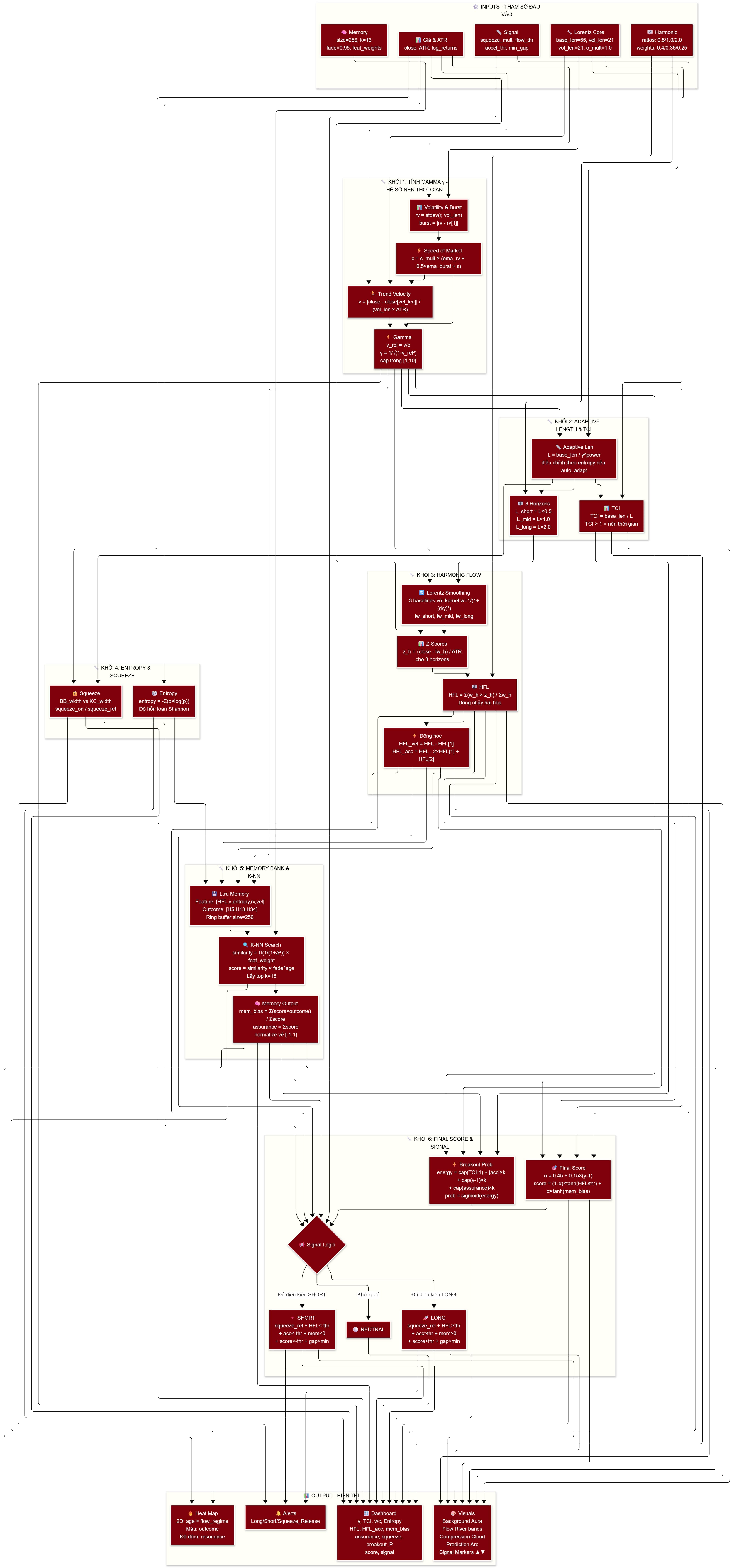
1.4 Cách hoạt động của chỉ báo
A. Đầu vào (Inputs) và vai trò:
- base_len (Base Length, mặc định 55): Chiều dài cơ sở khi thị trường bình thường (γ ≈ 1). Giá trị này là "neo" để tính adaptive_length = base_len / γ^power. Thấp hơn (21-34) → phản ứng nhanh cho tài sản biến động; cao hơn (89-144) → ổn định cho tài sản chậm.
- vel_len (Velocity Window, mặc định 21): Số nến dùng để tính vận tốc xu hướng (v). v = |close - close[vel_len]| / (vel_len × ATR). Ngắn hơn → gamma nhạy hơn; dài hơn → gamma ổn định.
- vol_len (Volatility Window, mặc định 21): Số nến dùng để tính realized volatility (stdev của log returns) và burst (thay đổi đột ngột của volatility). Dùng để tính c (speed of market).
- c_multiplier (Speed Multiplier, mặc định 1.0): Hệ số nhân cho c. Thấp hơn → c nhỏ hơn → dễ đạt v/c cao → gamma tăng nhanh. Cao hơn → c lớn hơn → khó đạt gamma cao.
- short_ratio, mid_ratio, long_ratio (mặc định 0.5, 1.0, 2.0): Tỷ lệ chia adapt_len thành 3 horizon ngắn/trung/dài. Len_short = adapt_len × 0.5; Len_mid = adapt_len × 1.0; Len_long = adapt_len × 2.0.
- w_short, w_mid, w_long (mặc định 0.4, 0.35, 0.25): Trọng số khi trộn 3 z-score từ 3 horizon thành HFL. Tăng w_short → HFL nhạy hơn; tăng w_long → HFL chậm hơn.
- mem_size (Memory Size, mặc định 256): Kích thước ring buffer lưu các feature vector và outcome. Càng lớn → nhớ càng nhiều pattern quá khứ → CPU nặng hơn.
- k_neighbors (mặc định 16): Số hàng xóm gần nhất (k-NN) tham gia vote khi tìm bộ nhớ tương đồng. Nhỏ → phản ứng; lớn → trơn.
- mem_fade (Memory Fade, mặc định 0.95): Hệ số giảm dần theo tuổi. weight_age = mem_fade^age_bars. Thấp (0.8-0.9) → ưu tiên gần; cao (0.95-0.99) → giữ bộ nhớ lâu.
- squeeze_mult, flow_thr, accel_thr: Ngưỡng cho squeeze (BB < KC × squeeze_mult), flow tối thiểu, và gia tốc tối thiểu để tạo tín hiệu.
B. Các khối logic chính và vai trò:
B1. Tính Gamma (γ) — Hệ số nén thời gian:
- Tính log return: r = log(close / close[1])
- Tính realized volatility: rv = stdev(r, vol_len)
- Tính burst: burst = |rv - rv[1]|
- Tính speed of market: c = c_multiplier × (ema(rv) + 0.5 × ema(burst) + epsilon)
- Tính vận tốc xu hướng: v = |close - close[vel_len]| / (vel_len × ATR)
- Tính tỷ lệ vận tốc: v_rel = v / c
- Tính gamma: gamma = 1 / sqrt(1 - v_rel²), giới hạn trong [1, 10]
- Vai trò: Gamma đại diện cho "tốc độ thời gian thị trường". Khi gamma tăng → thời gian bị nén → cần phân tích nhanh hơn.
B2. Tính Adaptive Length (L) — Điều chỉnh khung nhìn:
- adapt_len = base_len / gamma^power
- Nếu auto_adapt = true, còn điều chỉnh thêm bởi entropy.
- Vai trò: Khi gamma cao → adapt_len nhỏ → chỉ báo "nhìn ngắn hơn" để bắt kịp thị trường tăng tốc.
B3. Tính Lorentzian Smoothing — Tạo baseline hài hòa:
- Với mỗi horizon (short, mid, long), quét lại max_kernel_len nến.
- Mỗi nến i cách hiện tại có trọng số: w_i = 1 / (1 + (d/gamma)²), với d = i / adapt_len
- Baseline: lw_h = Σ(w_i × price[i]) / Σ(w_i)
- Z-score: z_h = (close - lw_h) / ATR
- Vai trò: Tạo ra 3 z-score (short, mid, long) đại diện cho độ lệch của giá so với baseline trong 3 tầm nhìn khác nhau.
B4. Tính HFL (Harmonic Flow) — Dòng chảy hài hòa:
- HFL = (w_short × z_short + w_mid × z_mid + w_long × z_long) / (w_short + w_mid + w_long)
- Vai trò: HFL là "nhiệt độ" của thị trường trong thời gian cong. Dương → bias tăng; âm → bias giảm.
B5. Tính HFL_vel và HFL_acc — Động học flow:
- Vận tốc: HFL_vel = HFL - HFL[1]
- Gia tốc: HFL_acc = HFL - 2×HFL[1] + HFL[2]
- Vai trò: HFL_vel cho biết flow đang tăng hay giảm. HFL_acc cho biết độ cong (turning point) — spike HFL_acc thường báo hiệu thay đổi mạnh.
B6. Tính Entropy — Độ hỗn loạn:
- Dựa trên Shannon entropy của phân bố |log returns|.
- entropy = -Σ(p_i × log(p_i)), với p_i là tỷ trọng của mỗi bin.
- Vai trò: Cao → thị trường hỗn loạn, khó dự đoán. Thấp → thị trường có trật tự, dễ phân tích hơn.
B7. Tính Squeeze và TCI — Nén biến động:
- BB width = 2 × stdev(close, adapt_len)
- KC width = 2 × ATR(adapt_len)
- squeeze_on = (BB_width < KC_width × squeeze_mult)
- squeeze_rel = squeeze_on[1] and not squeeze_on (vừa thoát squeeze)
- TCI: TCI = base_len / adapt_len
- Vai trò: Squeeze = lò xo nén → năng lượng tích tụ. TCI > 1 → thời gian đang nén. Kết hợp cả hai → dự đoán bùng nổ.
B8. Bộ nhớ K-NN — Tìm kịch bản quá khứ tương đồng:
-
Lưu trữ: Mỗi nến confirmed, lưu vào ring buffer:
- Feature: [HFL, gamma, entropy, ema(rv), HFL_vel]
- Outcome: Forward returns tại H5, H13, H34 (ví dụ: return sau 5 nến, 13 nến, 34 nến)
-
Tìm kiếm: Với feature hiện tại, tính similarity với mỗi neighbor:
- Per-dimension kernel: k(Δ) = 1 / (1 + Δ²)
- Similarity = tích các kernel theo 5 chiều, có trọng số user định nghĩa (feat_w_flow, feat_w_gamma, ...)
- Age fade: weight = mem_fade^age_bars
- Score neighbor: s_i = similarity_i × weight_age_i
-
Vote: Lấy k neighbors có score cao nhất.
- Mem Bias: Σ(s_i × outcome_i) / Σ(s_i) → trung bình có trọng số của forward return
- Assurance: Σ(s_i) → tổng confidence mass
- Normalize: mem_bias_norm = tanh(mem_bias / (ATR × scale)) → đưa về [-1, 1]
- Vai trò: Bộ nhớ cho biết "quá khứ nói gì về hiện tại". Khi assurance cao và mem_bias cùng chiều HFL → tín hiệu mạnh.
B9. Tính Breakout Probability — Xác suất bùng nổ:
- Energy = cap(TCI - 1, max=2) + |HFL_acc| × k + cap(gamma - 1, max=3) × k + cap(mem_assurance, max=2) × k
- Breakout_prob = sigmoid(energy) = 1 / (1 + exp(-energy))
- Vai trò: Tổng hợp các yếu tố nén + gia tốc + gamma + memory thành một số từ 0-1. > 0.7 → khả năng breakout cao.
B10. Tính Final Score — Điểm tổng hợp:
- Blend ratio: alpha_mem = 0.45 + 0.15 × (gamma - 1) → khi gamma cao, tăng tỷ trọng memory
- Final_score = (1 - alpha_mem) × tanh(HFL / (flow_thr × 1.5)) + alpha_mem × tanh(mem_bias_norm)
- Vai trò: Kết hợp flow hiện tại và bias từ bộ nhớ. Gamma càng cao → càng tin bộ nhớ (vì thị trường tăng tốc, pattern quá khứ quan trọng hơn).
B11. Sinh tín hiệu LONG/SHORT:
- Long: squeeze_rel + HFL > flow_thr + HFL_acc > accel_thr + mem_bias_norm > 0 + final_score > score_thr + gap từ signal trước > min_gap
- Short: squeeze_rel + HFL < -flow_thr + HFL_acc < -accel_thr + mem_bias_norm < 0 + final_score < -score_thr + gap > min_gap
- Vai trò: Chỉ xuất marker khi đủ confluence và tránh spam tín hiệu.
C. Đầu ra (Outputs) tương ứng với hiển thị:
- HFL → Flow River: flow_up/flow_dn = close ± HFL × flow_scale. Hiển thị dải xanh/đỏ quanh giá.
- TCI → Compression Cloud: comp_up/comp_dn = close × (1 ± (TCI-1) × 0.02). Hiển thị vùng cam.
- HFL_vel, HFL_acc, mem_bias → Prediction Arc: pred_arc = close + v_price × dt + 0.5 × a_price × dt². Hiển thị đường cong dự đoán.
- long_fire/short_fire → Marker: Hình tam giác ▲/▼ trên/dưới nến.
- final_score → Background Aura: Màu nền xanh/đỏ nhạt.
- Dashboard: Hiển thị tất cả các biến quan trọng (gamma, TCI, HFL, mem_bias, ...).
- Heat Map: Tạo bảng 2D từ mảng heat_w và heat_val, chia theo age bins (X) và flow bins (Y).
Giả sử nến hiện tại: close=50000, ATR=500, base_len=55.
- Tính log return: r = log(50000/49800) ≈ 0.004
- Tính rv = stdev(r, 21) ≈ 0.02; burst ≈ 0.001
- Tính c = 1.0 × (ema(0.02) + 0.5 × ema(0.001)) ≈ 0.021
- Tính v = |50000 - 48000| / (21 × 500) ≈ 0.19
- v_rel = 0.19 / 0.021 ≈ 9.05 (vượt ngưỡng, cap lại v_rel < 1 → sẽ cap để không NaN)
- Giả sử sau cap: v_rel = 0.85 → gamma = 1 / sqrt(1 - 0.85²) ≈ 1.90
- adapt_len = 55 / 1.90^1.0 ≈ 29 nến → TCI = 55/29 ≈ 1.90 (thời gian bị nén)
- Tính 3 horizon: Len_short ≈ 14, Len_mid ≈ 29, Len_long ≈ 58
- Quét Lorentz kernel, tính z_short ≈ 1.2, z_mid ≈ 0.8, z_long ≈ 0.5
- HFL = (0.4×1.2 + 0.35×0.8 + 0.25×0.5) / 1.0 ≈ 0.885 (bias tăng mạnh)
- HFL_vel = 0.885 - 0.7 = 0.185; HFL_acc = 0.885 - 2×0.7 + 0.6 = 0.085 (dương → đang tăng tốc)
- Entropy ≈ 2.5 (trung bình); squeeze_on = false, squeeze_rel = true (vừa thoát squeeze)
- K-NN tìm 16 neighbors, mem_bias_norm ≈ 0.4 (quá khứ ủng hộ tăng), assurance ≈ 1.5 (tin cậy cao)
- Breakout_prob = sigmoid(1.9 + 0.085×k + 0.9×k + 1.5×k) ≈ 0.75 (75% khả năng breakout)
- alpha_mem = 0.45 + 0.15×(1.9-1) = 0.585
- final_score = (1-0.585)×tanh(0.885/0.3) + 0.585×tanh(0.4) ≈ 0.65 (bias tăng mạnh)
- Long signal = true (đủ điều kiện) → Vẽ marker LONG ▲
- Prediction Arc = 50000 + (0.185×flow_scale)×10 + 0.5×(0.085×flow_scale)×100 ≈ 50500 (chiếu 10 nến tới giá khoảng 50500)
Kết luận: Với flow mạnh (HFL=0.885), gia tốc dương, bộ nhớ ủng hộ, vừa thoát squeeze, TCI cao → chỉ báo xuất tín hiệu LONG với độ tin cậy cao. Dashboard hiển thị Score=0.65 màu xanh, Breakout P=75%, Signal=🚀 LONG ▲.


Dùng phân tích trên + Code phía dưới để ra lệnh cho AI chỉnh sửa chỉ báo, chuyển thành bot trade mà không cần biết code!
Cách làm tại đây -> 👉ZERO2HERO👈
					//@version=5
indicator("Lorentzian Harmonic Flow - Temporal Market Dynamic ", shorttitle="⚡ LHF", overlay=true, max_labels_count=500, max_lines_count=500, max_bars_back=5000)

//==============================================================================
// ⚡ LORENTZIAN HARMONIC FLOW - TEMPORAL MARKET DYNAMICS
//==============================================================================
//
// 🌌 THEORETICAL FOUNDATION: MARKET TIME AS CURVED SPACETIME
//
// Traditional indicators treat time as linear and uniform—each bar weighted
// equally, each moment progressing at constant velocity. But markets don't
// behave this way. During explosive volatility, price action "compresses"
// weeks of movement into minutes. During consolidation, time "dilates" as
// price meanders without conviction.
//
// The Lorentzian Harmonic Flow (LHF Pro) treats this phenomenon literally,
// borrowing from Einstein's special relativity to model market time dilation.
//
// 🔬 THE LORENTZ TRANSFORMATION: FROM PHYSICS TO FINANCE
//
// In special relativity, the Lorentz gamma factor governs time dilation:
//
// γ = 1 / √(1 - v²/c²)
//
// Where:
// • v = velocity of an object (here: trend velocity, normalized by ATR)
// • c = speed of light (here: "speed of market" ~ realized volatility + bursts)
// • γ = time dilation factor (γ > 1 means time compresses)
//
// When trend velocity approaches market's "speed limit" (high vol), gamma
// spikes → time compresses → we use shorter lookback windows to capture
// the accelerated information flow. Conversely, in sleepy markets (v ≈ 0),
// gamma ≈ 1 and time flows normally.
//
// This isn't a metaphor—it's a quantitative framework that adapts every
// parameter to the market's intrinsic clock.
//
// 🎼 HARMONIC FLOW: MULTI-HORIZON RESONANCE IN CURVED TIME
//
// We compute three Lorentz-weighted moving averages across short, mid, and
// long horizons—each horizon scaled by gamma. The kernel weights distant
// bars using the Lorentzian distribution:
//
// K(x,y) = 1 / (1 + (d/γ)²)
//
// This creates heavy-tailed influence: recent extremes matter more than
// Gaussian models would suggest. The three horizons are then harmonically
// blended into a single flow index (HFL), revealing the market's directional
// "current" in compressed time.
//
// Flow velocity (dHFL/dt) and acceleration (d²HFL/dt²) then capture momentum
// and turning points with astonishing sensitivity.
//
// 🧠 THE MEMORY BANK: LONG-TERM PATTERN RESONANCE
//
// Markets have memory. Current conditions resonate with past regimes. LHF Pro
// maintains a multi-dimensional memory bank storing:
//
// FEATURES (5D):
// 1. Harmonic Flow (HFL)
// 2. Gamma (temporal compression state)
// 3. Entropy (chaos/order measure)
// 4. Realized Volatility (market speed)
// 5. Flow Velocity (momentum signature)
//
// OUTCOMES (3 horizons):
// • H5: 5-bar forward return
// • H13: 13-bar forward return
// • H34: 34-bar forward return
//
// At each bar, we perform k-nearest neighbors (KNN) search in this feature
// space using Lorentzian distance weighting. The k most similar historical
// states vote on future direction, weighted by:
// • Feature similarity (Lorentzian kernel per dimension)
// • Age fade (exponential decay on old memories)
//
// The result: a memory-derived bias that blends with real-time flow to
// produce a final prediction score. When current state strongly resonates
// with past profitable setups, confidence soars.
//
// 🔥 THE HEAT MAP: VISUAL LONG-TERM MEMORY INDEXING
//
// A 2D grid visualizes WHERE in memory space the market is resonating:
// • X-axis: Memory age (recent → distant past)
// • Y-axis: Flow regime (bearish → neutral → bullish)
// • Color/Intensity: Expected outcome + resonance strength
//
// Hot cells reveal which historical regimes are firing. This is your edge:
// seeing the invisible patterns that govern current price action.
//
// 🌀 TEMPORAL COMPRESSION & SQUEEZE DYNAMICS
//
// We detect Bollinger Band "squeeze" conditions (BB width < KC width), which
// signal volatility contraction. Combined with gamma spikes and flow
// acceleration, these become breakout inception points. The indicator
// calculates a breakout probability from:
// • Temporal compression index (TCI = base_length / adaptive_length)
// • Flow acceleration magnitude
// • Gamma elevation
// • Memory resonance strength
//
// When all align, the market is coiled to explode.
//
// 🎯 TRADING WITH LHF PRO
//
// SIGNAL GENERATION:
// • LONG: Squeeze release + positive flow + positive acceleration + memory bias > 0
// • SHORT: Squeeze release + negative flow + negative acceleration + memory bias < 0
// • Real-time mode allows early entries on bias shifts even without squeeze
//
// CONFLUENCE CHECKLIST:
// 1. Check dashboard final score (blend of flow + memory)
// 2. Verify gamma/TCI for compression state
// 3. Inspect heat map for regime resonance
// 4. Confirm breakout probability > 60-70%
// 5. Enter on marker, stop beyond recent pivot, target via prediction arc
//
// MULTI-TIMEFRAME:
// • Use higher TF (4h/Daily) for bias
// • Execute on lower TF (15m/1h) for precision entries
// • Memory bank captures cross-timeframe patterns automatically
//
// 💡 PHILOSOPHICAL IMPLICATIONS
//
// If markets are deterministic chaos with embedded memory, then similar
// initial conditions (feature vectors) should yield similar outcomes. LHF Pro
// makes this concrete: it measures "initial conditions" in curved market time,
// searches historical analogs, and projects futures based on weighted past
// trajectories.
//
// You're not predicting—you're resonating with the market's harmonic structure.
//
//==============================================================================
// 📘 USER GUIDE: MASTERING LHF PRO
//==============================================================================
//
// 🔮 LORENTZ CORE SETTINGS
//
// Auto-Adapt: Enable for dynamic parameter adjustment based on gamma/entropy.
// Disable for static backtesting or stable assets.
//
// Base Length: The "rest frame" time period. Market time will compress/dilate
// around this value. 34 is balanced; lower (21) for fast markets, higher (55)
// for slow.
//
// Velocity Window: How many bars to measure trend speed. Shorter (7-10) for
// scalping, longer (14-21) for position trading.
//
// Volatility Window: Realized vol calculation period. Match to your typical
// vol regime length.
//
// Speed-of-Market Multiplier (c): Higher values make gamma more sensitive
// (more compression). 1.0-1.2 for crypto, 1.4-1.8 for stocks/forex.
//
// Gamma Compression Power: How strongly gamma compresses time. 1.0 is linear,
// <1.0 softens, >1.0 amplifies. Adjust if adaptive lengths swing too wildly.
//
// Max Kernel Span: Computational limit on Lorentz smoothing. Lower if slow.
//
// 🎼 HARMONIC FLOW SETTINGS
//
// Short/Mid/Long Horizon Ratios: Multipliers on adaptive length for the three
// time horizons. Default (0.5, 1.0, 2.5) captures fast/medium/slow flows.
//
// Weights: How much each horizon contributes to final HFL. Increase short
// weight for responsiveness, long weight for stability.
//
// 📈 SIGNAL CONTROLS
//
// Squeeze Strictness: Lower (0.6-0.8) = stricter squeeze, fewer but cleaner
// breakouts. Higher (1.2-1.4) = more signals, noisier.
//
// Flow Threshold: Minimum HFL magnitude to consider directional. Raise to
// filter weak moves.
//
// Acceleration Threshold: Minimum HFL acceleration for breakout confirmation.
// Higher = only explosive moves.
//
// Min Bars Between Signals: Prevents signal spam. 3-5 for active trading,
// 8-15 for swing.
//
// Confirmation Mode:
// • Aggressive: Lower thresholds, more signals, higher false positives
// • Balanced: Optimal risk/reward
// • Conservative: Strict thresholds, fewer signals, higher accuracy
//
// Real-Time Mode: Enables signals on current bar (may repaint slightly).
// Disable for confirmed-bar-only signals.
//
// 🧠 MEMORY BANK CONTROLS
//
// Enable Memory Bank + Heat Map: Toggle entire memory system. Disable if
// CPU-constrained or prefer pure flow signals.
//
// Memory Size: Number of historical states stored (64-1024). More = better
// pattern recognition but slower. 256-512 is sweet spot.
//
// Memory Fade: Exponential decay on old memories (0.90-1.00). Lower = only
// recent history matters. 0.995 balances recency with long-term patterns.
//
// K Neighbors: How many similar states to query (3-31). More = smoother bias,
// fewer = reactive. 9-15 recommended.
//
// Prediction Horizon:
// • H5: Fast, 5-bar forward (scalping)
// • H13: Medium, 13-bar forward (day trading)
// • H34: Slow, 34-bar forward (swing)
// • Blend: Weighted combination (recommended)
//
// Feature Weights: Adjust importance of each dimension in KNN similarity:
// • Flow: Current directional state
// • Gamma: Temporal compression similarity
// • Entropy: Chaos regime matching
// • Volatility: Market speed matching
// • Flow Velocity: Momentum similarity
//
// Normalize to sum = 1.0 for best results, but not required.
//
// 🔥 MEMORY HEAT MAP
//
// Show Memory Heat Map: Displays 2D resonance grid.
//
// Position: Screen location.
//
// Age Bins (X): Columns = memory age buckets. More = finer time resolution
// but smaller cells. 6-10 optimal.
//
// Flow Bins (Y): Rows = flow regime buckets (bear/neutral/bull). 5-7 optimal.
//
// Heat Min/Max Opacity: Intensity range. Min (20-40) for faint weak signals,
// Max (70-90) for strong resonance.
//
// READING THE HEAT MAP:
// • Green cells: Bullish memory resonance at that age/regime
// • Red cells: Bearish memory resonance
// • Bright cells: Strong historical pattern match
// • Faint cells: Weak or no pattern
// • Look for vertical "hot streaks" = regime persistence across time
// • Look for horizontal "hot streaks" = similar outcomes across regimes
//
// 🎨 VISUAL CONTROLS
//
// Background Aura: Tints chart during signal conditions. Subtle bias indicator.
//
// Flow River: Plots upper/lower flow bands around price. Visualizes HFL
// magnitude and direction.
//
// Prediction Arc: Projects future price using flow kinematics + memory bias.
// Not a target—a probabilistic trajectory.
//
// Compression Cloud: Expands during temporal compression (high gamma/TCI).
// Warning zone for volatility expansion.
//
// Signal Markers: Triangle markers at entry points.
//
// Adjust transparencies to suit your chart aesthetic and prevent clutter.
//
// 🏆 DASHBOARD
//
// Displays real-time metrics:
// • Gamma: Current time dilation factor
// • TCI: Temporal compression index (>1 = compressed)
// • v/c: Velocity ratio (approaching 1 = extreme speed)
// • Entropy: Market chaos level
// • HFL: Harmonic flow index
// • HFL_acc: Flow acceleration
// • Mem Bias: Memory-derived directional expectation
// • Assurance: Memory confidence (sum of neighbor weights)
// • Squeeze: Current squeeze state
// • Breakout P: Breakout probability %
// • Score: Final blended prediction score
// • K: Number of neighbors found
// • Signal: Current signal state
//
// 💼 PROFESSIONAL USAGE TIPS
//
// 1. REGIME DETECTION: Watch gamma and TCI. Compression (TCI > 1.1) precedes
// breakouts. Dilation (TCI < 0.95) signals ranging markets.
//
// 2. MEMORY CONFIRMATION: Don't trade against strong memory bias unless you
// have external edge. When mem_assurance > 2.0 and bias aligns with flow,
// conviction is high.
//
// 3. HEAT MAP PATTERNS: Before major moves, you'll often see heat concentrate
// in recent age bins (left columns) as market "remembers" fresh setups.
//
// 4. ENTROPY FILTER: High entropy (>0.6) = chaos. Reduce position size or
// wait for entropy to drop before entering.
//
// 5. ARC TARGETING: Use prediction arc slope, not absolute level. Steep arc
// = strong momentum expected.
//
// 6. BACKTESTING: Disable real-time mode, set conservative confirmation,
// tune thresholds on historical data. Then re-enable real-time for live.
//
// 7. MULTI-ASSET: LHF Pro adapts across assets due to ATR normalization and
// auto-adapt. You may still want asset-specific presets (save as templates).
//
// Remember: This is a complex, adaptive system. Spend time observing before
// trading. Let the memory bank fill (50+ bars minimum), watch regime
// transitions, and learn your instrument's signature patterns.
//
// The market's memory is YOUR memory. Use it wisely.
//
//==============================================================================
// 📊 INPUT CONFIGURATION
//==============================================================================
group_core = "🔮 Lorentz Core"
use_auto_adapt = input.bool(true, "Auto-Adapt (Vol/Entropy)", group=group_core, tooltip='🎯 WHAT IT IS: Dynamic parameter adjustment based on gamma and entropy.\n\n⚡ HOW IT WORKS: When gamma spikes (high v/c), adaptive length shrinks, compressing the time window. When entropy rises, kernel periods expand to smooth noise. This creates an intelligent system that breathes with the market.\n\n📈 ENABLED: Parameters self-optimize for current temporal state\n📉 DISABLED: Static values for consistent backtesting\n\n💡 PRO TIP: Enable for live trading on volatile assets. Disable when optimizing parameters or trading stable blue-chips.')
base_len = input.int(34, "Base Length (Time Kernel)", 5, 300, group=group_core, tooltip='🎯 WHAT IT IS: The "rest frame" time period before Lorentz compression.\n\n⚡ HOW IT WORKS: This is your anchor length. Actual operative length will be base_len / γ^power. Think of it as the time horizon in a calm market.\n\n📊 SUGGESTED VALUES:\n• Scalping: 21-28\n• Day Trading: 34-55\n• Swing Trading: 55-89\n• Position Trading: 89-144\n\n💡 PRO TIP: Start at 34. If signals lag, reduce to 21. If too noisy, increase to 55. This is your single most important tuning parameter.')
vel_len = input.int(14, "Velocity Window", 3, 200, group=group_core, tooltip='🎯 WHAT IT IS: Lookback period for trend velocity calculation.\n\n⚡ HOW IT WORKS: Computes (close - close[vel_len]) / (vel_len * ATR) to get normalized speed. This becomes "v" in the Lorentz equation.\n\n📊 SUGGESTED VALUES:\n• Fast/Scalp: 7-10\n• Standard: 14-21\n• Slow/Trend: 21-34\n\n💡 PRO TIP: Shorter periods make gamma more reactive. Match this to your trading timeframe.')
vol_len = input.int(20, "Volatility Window", 5, 300, group=group_core, tooltip='🎯 WHAT IT IS: Window for realized volatility and burst calculation.\n\n⚡ HOW IT WORKS: Calculates standard deviation of log returns plus volatility-of-volatility. This sets "c" (speed of market) in the Lorentz equation.\n\n📊 SUGGESTED VALUES:\n• High-frequency data: 14-20\n• Standard timeframes: 20-30\n• Long-term bias: 30-50\n\n💡 PRO TIP: Increase if c_multiplier causes gamma to spike too often. Decrease for more sensitive compression detection.')
c_multiplier = input.float(1.4, "Speed-of-Market Multiplier (c)", 0.4, 5.0, 0.1, group=group_core, tooltip='🎯 WHAT IT IS: Scales the "speed of light" equivalent for markets.\n\n⚡ HOW IT WORKS: c = c_multiplier × (realized_vol + burst). Higher values make it harder for velocity to approach c, reducing gamma spikes. Lower values increase sensitivity.\n\n📊 SUGGESTED VALUES:\n• Crypto (high vol): 0.8-1.2\n• Forex (medium vol): 1.2-1.6\n• Stocks/Indices (lower vol): 1.4-2.0\n• Very stable assets: 2.0-3.0\n\n💡 PRO TIP: If gamma rarely exceeds 1.5, lower this. If gamma constantly spikes above 3.0, raise it. Aim for gamma peaks of 2-4 during strong moves.')
gamma_power = input.float(1.00, "Gamma Compression Power", 0.5, 2.5, 0.05, group=group_core, tooltip='🎯 WHAT IT IS: Exponent applied to gamma in time compression formula.\n\n⚡ HOW IT WORKS: adaptive_length = base_len / γ^power. Power < 1.0 softens compression. Power > 1.0 amplifies it.\n\n📊 SUGGESTED VALUES:\n• Subtle adaptation: 0.7-0.9\n• Linear (default): 1.0\n• Aggressive compression: 1.1-1.5\n• Extreme (experimental): 1.5-2.5\n\n💡 PRO TIP: Keep at 1.0 unless adaptive_len swings are too wild (lower to 0.8) or too subtle (raise to 1.2).')
max_kernel_len = input.int(60, "Max Kernel Span (Efficiency)", 10, 200, group=group_core, tooltip='🎯 WHAT IT IS: Maximum bars used in Lorentz-weighted smoothing loop.\n\n⚡ HOW IT WORKS: Limits computational load. Lorentz kernels have heavy tails, so we cap iteration to prevent slowdown.\n\n📊 SUGGESTED VALUES:\n• Fast execution: 30-50\n• Balanced: 50-80\n• Maximum quality: 80-150\n\n💡 PRO TIP: Lower this if indicator lags on chart load. 60 is optimal for most use cases.')
group_harm = "🎼 Harmonic Flow"
short_ratio = input.float(0.5, "Short Horizon Ratio", 0.2, 1.5, 0.05, group=group_harm, tooltip='🎯 WHAT IT IS: Multiplier for short-term harmonic horizon.\n\n⚡ HOW IT WORKS: short_len = adaptive_len × short_ratio. Lower values create faster-responding flow component.\n\n📊 SUGGESTED VALUES:\n• Very fast: 0.3-0.4\n• Default: 0.5\n• Smoothed: 0.6-0.8\n\n💡 PRO TIP: Decrease for scalping, increase for swing trading.')
mid_ratio = input.float(1.0, "Mid Horizon Ratio", 0.5, 2.5, 0.05, group=group_harm, tooltip='🎯 WHAT IT IS: Multiplier for medium-term harmonic horizon.\n\n⚡ HOW IT WORKS: mid_len = adaptive_len × mid_ratio. Typically set to 1.0 to match base compressed time.\n\n💡 PRO TIP: Keep at 1.0 unless you want to shift the mid horizon faster (0.7) or slower (1.3).')
long_ratio = input.float(2.5, "Long Horizon Ratio", 1.0, 5.0, 0.1, group=group_harm, tooltip='🎯 WHAT IT IS: Multiplier for long-term harmonic horizon.\n\n⚡ HOW IT WORKS: long_len = adaptive_len × long_ratio. Provides trend/bias context.\n\n📊 SUGGESTED VALUES:\n• Fast bias: 1.5-2.0\n• Default: 2.5\n• Strong trend filter: 3.0-4.0\n\n💡 PRO TIP: Increase for stronger trend filtering, decrease for more reactive signals.')
w_short = input.float(0.45, "Weight: Short", 0.0, 1.0, 0.05, group=group_harm, tooltip='🎯 WHAT IT IS: Weight of short horizon in final HFL blend.\n\n⚡ HOW IT WORKS: HFL = (w_short×z_s + w_mid×z_m + w_long×z_l) / sum(weights).\n\n📊 SUGGESTED WEIGHTS:\n• Scalping: 0.60 short, 0.30 mid, 0.10 long\n• Day Trading: 0.45 short, 0.35 mid, 0.20 long (default)\n• Swing: 0.30 short, 0.40 mid, 0.30 long\n\n💡 PRO TIP: Higher short weight = faster signals but more whipsaws.')
w_mid = input.float(0.35, "Weight: Mid", 0.0, 1.0, 0.05, group=group_harm, tooltip='🎯 WHAT IT IS: Weight of mid horizon in HFL blend.\n\n💡 PRO TIP: This is your stability anchor. Increase for smoother flow.')
w_long = input.float(0.20, "Weight: Long", 0.0, 1.0, 0.05, group=group_harm, tooltip='🎯 WHAT IT IS: Weight of long horizon in HFL blend.\n\n💡 PRO TIP: Increase for strong trend bias, decrease for more reactive entries.')
group_sig = "📈 Signals"
signal_type = input.string("Directional Bias", "Signal Type", ["Squeeze Only","Directional Bias","Hybrid"], group=group_sig, tooltip='🎯 WHAT IT IS: Controls when signals are generated.\n\n⚡ HOW IT WORKS:\n• Squeeze Only: Rare but high-quality signals on squeeze releases\n• Directional Bias: Continuous market state reading (shows current bias even without squeeze)\n• Hybrid: Both squeeze and strong directional signals\n\n📊 USAGE:\n• Squeeze Only: Position trading, patient entries\n• Directional Bias: Active trading, always know market state\n• Hybrid: Balanced approach\n\n💡 PRO TIP: Start with Directional Bias to understand the indicator. Switch to Squeeze Only for higher-quality setups.')
squeeze_mult = input.float(1.0, "Squeeze Strictness (BB<KC Mult)", 0.6, 1.6, 0.05, group=group_sig, tooltip='🎯 WHAT IT IS: Threshold for Bollinger/Keltner squeeze detection.\n\n⚡ HOW IT WORKS: Squeeze activates when BB_width < KC_width × squeeze_mult. Lower = stricter (fewer squeezes), higher = looser (more squeezes).\n\n📊 SUGGESTED VALUES:\n• Strict (major squeezes only): 0.7-0.85\n• Balanced: 0.95-1.05\n• Loose (frequent setups): 1.1-1.3\n\n💡 PRO TIP: Lower this in ranging markets to catch only true compression. Raise in trending markets to get more breakout attempts.')
flow_thr = input.float(0.15, "Flow Threshold", 0.05, 1.0, 0.05, group=group_sig, tooltip='🎯 WHAT IT IS: Minimum HFL magnitude to consider directional signal.\n\n⚡ HOW IT WORKS: HFL is normalized deviation from Lorentz-weighted baselines. Typical range: -2 to +2. Threshold of 0.15 filters weak/neutral states.\n\n📊 SUGGESTED VALUES:\n• Very sensitive: 0.05-0.10\n• Balanced: 0.12-0.18\n• Conservative: 0.20-0.35\n\n💡 PRO TIP: Raise this to reduce signals and increase quality. Lower for more entries.')
accel_thr = input.float(0.10, "Acceleration Threshold", 0.02, 1.0, 0.02, group=group_sig, tooltip='🎯 WHAT IT IS: Minimum HFL acceleration for breakout confirmation.\n\n⚡ HOW IT WORKS: HFL_acc = HFL - 2×HFL[1] + HFL[2]. Detects inflection points (second derivative). Higher threshold = only explosive accelerations qualify.\n\n📊 SUGGESTED VALUES:\n• Sensitive (catch early): 0.05-0.08\n• Default: 0.10\n• Explosive only: 0.15-0.25\n\n💡 PRO TIP: Combine with flow threshold. If both are high, you get rare but powerful signals.')
min_gap = input.int(5, "Min Bars Between Signals", 1, 50, group=group_sig, tooltip='🎯 WHAT IT IS: Anti-spam filter—minimum bars between consecutive signals.\n\n⚡ HOW IT WORKS: Prevents signal clustering during choppy conditions.\n\n📊 SUGGESTED VALUES:\n• Scalping: 1-3\n• Day trading: 4-8\n• Swing: 10-20\n\n💡 PRO TIP: Increase if you see multiple signals in same small move.')
confirm_mode = input.string("Balanced", "Confirmation Mode", ["Aggressive","Balanced","Conservative"], group=group_sig, tooltip='🎯 WHAT IT IS: Preset adjustment to flow and acceleration thresholds.\n\n⚡ HOW IT WORKS:\n• AGGRESSIVE: 0.75× thresholds, more signals, higher risk\n• BALANCED: 1.0× thresholds (default)\n• CONSERVATIVE: 1.25× thresholds, fewer signals, higher quality\n\n💡 PRO TIP: Use Aggressive for scalping/high-frequency, Conservative for swing/position entries.')
realtime_mode = input.bool(true, "Real-Time Mode (faster signals)", group=group_sig, tooltip='🎯 WHAT IT IS: Allow signals on developing bars vs confirmed bars only.\n\n⚡ HOW IT WORKS:\n• TRUE: Signals can fire on current bar, enabling faster entries but slight repaint risk as bar develops\n• FALSE: Signals only on confirmed/closed bars\n\n💡 PRO TIP: Enable for live trading and alerts. Disable for clean backtesting.')
group_mem = "🧠 Memory Bank"
enable_mem = input.bool(true, "Enable Memory Bank + Heat Map", group=group_mem, tooltip='🎯 WHAT IT IS: Toggles the entire long-term memory system.\n\n⚡ HOW IT WORKS: Stores historical feature vectors and outcomes, performs KNN search, generates memory bias, and renders heat map.\n\n💡 PRO TIP: Disable if CPU-constrained or you prefer pure flow-based signals. Enable for maximum edge via pattern recognition.')
mem_size = input.int(512, "Memory Size (entries)", 64, 1024, group=group_mem, tooltip='🎯 WHAT IT IS: Number of historical states stored in ring buffer.\n\n⚡ HOW IT WORKS: Larger memory = more patterns recognized but slower computation. Memory fills over time (bars > 50+).\n\n📊 SUGGESTED VALUES:\n• Fast execution: 128-256\n• Balanced: 256-512 (default)\n• Maximum pattern depth: 512-1024\n\n💡 PRO TIP: Start at 512. Lower to 256 if chart loads slowly. Increase to 1024 for long-term pattern recognition on higher timeframes.')
mem_fade = input.float(0.995,"Memory Fade (older = less weight)", 0.90, 1.00, 0.001, group=group_mem, tooltip='🎯 WHAT IT IS: Exponential decay factor applied to memory age.\n\n⚡ HOW IT WORKS: weight = similarity × fade^age_bars. Lower fade = recent memory dominates. Higher fade = long-term patterns matter more.\n\n📊 SUGGESTED VALUES:\n• Recency-focused: 0.985-0.992\n• Balanced: 0.993-0.997\n• Long-term patterns: 0.998-0.9995\n\n💡 PRO TIP: 0.995 balances recency and history. Increase to 0.998 on higher timeframes where old patterns stay relevant.')
k_neighbors = input.int(13, "K Neighbors (Lorentz KNN)", 3, 31, group=group_mem, tooltip='🎯 WHAT IT IS: Number of nearest neighbors queried for outcome voting.\n\n⚡ HOW IT WORKS: Top-k most similar historical states vote on expected outcome, weighted by Lorentzian distance.\n\n📊 SUGGESTED VALUES:\n• Reactive: 5-9\n• Balanced: 11-15 (default: 13)\n• Smooth/Stable: 17-25\n\n💡 PRO TIP: Odd numbers avoid ties. More neighbors = smoother bias but slower to adapt. Fewer = reactive but noisy.')
pred_horizon = input.string("Blend", "Prediction Horizon", ["H5","H13","H34","Blend"], group=group_mem, tooltip='🎯 WHAT IT IS: Which future outcome horizon to use from memory.\n\n⚡ HOW IT WORKS:\n• H5: 5-bar forward return (fast/scalping)\n• H13: 13-bar forward return (day trading)\n• H34: 34-bar forward return (swing)\n• Blend: Weighted mix (0.5×H5 + 0.3×H13 + 0.2×H34)\n\n💡 PRO TIP: Use Blend for multi-timeframe edge. Use specific horizon if you have strict holding period.')
w_mem_flow = input.float(0.40, "Feature Weight: Flow", 0.0, 1.0, 0.05, group=group_mem, tooltip='🎯 WHAT IT IS: Weight of HFL in KNN similarity calculation.\n\n⚡ HOW IT WORKS: Higher weight = prioritize states with similar flow regime.\n\n💡 PRO TIP: Flow is your primary state descriptor. Keep this highest (0.3-0.5).')
w_mem_gamma = input.float(0.20, "Feature Weight: Gamma", 0.0, 1.0, 0.05, group=group_mem, tooltip='🎯 WHAT IT IS: Weight of gamma (temporal compression) in KNN.\n\n⚡ HOW IT WORKS: Higher weight = match historical states with similar time dilation.\n\n💡 PRO TIP: Important for regime matching. Compressed time behaves differently than dilated time.')
w_mem_entropy = input.float(0.15, "Feature Weight: Entropy", 0.0, 1.0, 0.05, group=group_mem, tooltip='🎯 WHAT IT IS: Weight of entropy (chaos measure) in KNN.\n\n⚡ HOW IT WORKS: Higher weight = match states with similar chaos/order levels.\n\n💡 PRO TIP: High entropy states should match high entropy history. Raise this if your asset has distinct chaos regimes.')
w_mem_vol = input.float(0.15, "Feature Weight: Volatility", 0.0, 1.0, 0.05, group=group_mem, tooltip='🎯 WHAT IT IS: Weight of realized volatility in KNN.\n\n⚡ HOW IT WORKS: Higher weight = match vol regimes.\n\n💡 PRO TIP: Useful for assets with distinct high/low vol periods (crypto, earnings).')
w_mem_mom = input.float(0.10, "Feature Weight: Flow Velocity", 0.0, 1.0, 0.05, group=group_mem, tooltip='🎯 WHAT IT IS: Weight of HFL velocity (momentum) in KNN.\n\n⚡ HOW IT WORKS: Higher weight = match momentum signature.\n\n💡 PRO TIP: Less critical than flow level itself. Keep lower unless momentum regime is key to your strategy.')
enable_pre_fill = input.bool(false, "Enable Memory Pre-Fill (Heavy Computation)", group=group_mem, tooltip='🎯 WHAT IT IS: Pre-fills memory bank with historical data on chart load.\n\n⚡ HOW IT WORKS: Scans up to 200 historical bars to populate memory immediately, enabling instant metrics.\n\n⚠️ WARNING: Significantly increases initial load time. Disable for faster chart rendering.\n\n💡 PRO TIP: Enable only if you need immediate historical context. Memory fills automatically in real-time anyway.')
group_heat = "🔥 Memory Heat Map"
show_heat = input.bool(true, "Show Memory Heat Map", group=group_heat, tooltip='🎯 WHAT IT IS: 2D visualization of long-term memory resonance.\n\n⚡ HOW IT WORKS: Grid shows where in memory space (age × flow regime) the current market is resonating. Color intensity = expected outcome strength.\n\n💡 PRO TIP: Use this as a secondary confirmation. Hot cells in recent age + current flow regime = strong pattern match.')
heat_pos = input.string("Bottom Right", "Heat Map Position", ["Top Left","Top Right","Bottom Left","Bottom Right"], group=group_heat, tooltip='🎯 WHAT IT IS: Screen location of heat map table.\n\n💡 PRO TIP: Position where it doesnt block price action. Bottom corners usually best.')
heat_age_bins = input.int(8, "Age Bins (X)", 4, 12, group=group_heat, tooltip='🎯 WHAT IT IS: Number of columns in heat map (memory age buckets).\n\n⚡ HOW IT WORKS: X-axis divided into bins from recent (left) to distant (right) memory.\n\n📊 SUGGESTED VALUES:\n• Simple view: 5-6\n• Balanced: 7-9\n• Detailed: 10-12\n\n💡 PRO TIP: More bins = finer age resolution but smaller cells. 8 is optimal for most screens.')
heat_flow_bins = input.int(5, "Flow Bins (Y)", 3, 7, group=group_heat, tooltip='🎯 WHAT IT IS: Number of rows in heat map (flow regime buckets).\n\n⚡ HOW IT WORKS: Y-axis quantizes flow from bearish (top) to bullish (bottom).\n\n📊 SUGGESTED VALUES:\n• Simple (bear/neut/bull): 3\n• Balanced: 5 (default)\n• Detailed: 7\n\n💡 PRO TIP: 5 bins gives clear regime separation without clutter.')
heat_alpha_min = input.int(35, "Heat Min Opacity", 0, 100, group=group_heat, tooltip='🎯 WHAT IT IS: Minimum opacity for weakest resonance cells.\n\n⚡ HOW IT WORKS: Cells with low weight fade to this transparency.\n\n💡 PRO TIP: 30-40 keeps weak patterns barely visible.')
heat_alpha_max = input.int(80, "Heat Max Opacity", 0, 100, group=group_heat, tooltip='🎯 WHAT IT IS: Maximum opacity for strongest resonance cells.\n\n⚡ HOW IT WORKS: Cells with highest weight render at this opacity.\n\n💡 PRO TIP: 75-85 makes strong patterns pop without overwhelming chart.')
group_viz = "🎨 Visuals"
show_aura = input.bool(true, "Background Aura", group=group_viz, tooltip='🎯 WHAT IT IS: Background tint during signal states.\n\n⚡ HOW IT WORKS: Green on long signals, red on short signals.\n\n💡 PRO TIP: Subtle visual cue. Disable if you prefer clean chart background.')
aura_trans = input.int(92, "Aura Transparency", 0, 100, group=group_viz, tooltip='🎯 WHAT IT IS: Opacity of background aura.\n\n💡 PRO TIP: 90-95 for subtle effect, 80-85 for stronger visibility.')
show_flow = input.bool(true, "Show Flow River", group=group_viz, tooltip='🎯 WHAT IT IS: Upper/lower flow bands visualizing HFL magnitude.\n\n⚡ HOW IT WORKS: Plots close ± HFL×flow_scale, creating a "river" of directional pressure.\n\n💡 PRO TIP: When price crosses through the river, flow regime is shifting. Great confluence indicator.')
river_trans = input.int(80, "River Transparency", 0, 100, group=group_viz, tooltip='🎯 WHAT IT IS: Opacity of flow river lines and fill.\n\n💡 PRO TIP: 75-85 keeps river visible without dominating price action.')
show_arc = input.bool(true, "Show Prediction Arc", group=group_viz, tooltip='🎯 WHAT IT IS: Kinematic projection of future price based on flow velocity, acceleration, and memory bias.\n\n⚡ HOW IT WORKS: pred = close + v×dt + 0.5×a×dt². Not a price target—a trajectory estimate.\n\n💡 PRO TIP: Use arc slope/direction, not absolute value. Steep arc = strong expected momentum.')
arc_trans = input.int(70, "Arc Transparency", 0, 100, group=group_viz, tooltip='🎯 WHAT IT IS: Opacity of prediction arc line.\n\n💡 PRO TIP: 65-75 makes it visible but secondary to price.')
show_compress = input.bool(true, "Show Compression Cloud", group=group_viz, tooltip='🎯 WHAT IT IS: Expanding cloud during temporal compression (high TCI/gamma).\n\n⚡ HOW IT WORKS: Cloud width scales with TCI-1. Wide cloud = compressed time = volatility coil.\n\n💡 PRO TIP: Wide cloud + squeeze = high-probability breakout setup. Avoid mean-reversion trades inside wide clouds.')
compress_trans = input.int(92, "Compression Transparency", 0, 100, group=group_viz, tooltip='🎯 WHAT IT IS: Opacity of compression cloud fill.\n\n💡 PRO TIP: 90-95 for subtle warning zone.')
show_markers = input.bool(true, "Signal Markers", group=group_viz, tooltip='🎯 WHAT IT IS: Triangle markers at long/short signal bars.\n\n💡 PRO TIP: Core visual—rarely disable.')
group_dash = "🏆 Dashboard"
show_dashboard = input.bool(true, "Show Dashboard", group=group_dash, tooltip='🎯 WHAT IT IS: Real-time metrics table.\n\n💡 PRO TIP: Essential for understanding current state. Disable only for presentation/screenshot purposes.')
dash_pos = input.string("Top Right", "Position", ["Top Left","Top Right","Bottom Left","Bottom Right"], group=group_dash, tooltip='🎯 WHAT IT IS: Screen location of dashboard.\n\n💡 PRO TIP: Top right is standard for multi-monitor setups.')
dash_size = input.string("Large", "Size", ["Small","Normal","Large"], group=group_dash, tooltip='🎯 WHAT IT IS: Dashboard detail level.\n\n📊 OPTIONS:\n• Small: Minimal (6 rows)\n• Normal: Standard (11 rows)\n• Large: Full metrics (13 rows)\n\n💡 PRO TIP: Large for analysis, Normal for trading, Small for clean charts.')
theme = input.string("Supreme", "Theme", ["Supreme","Cosmic","Vortex","Heritage"], group=group_dash, tooltip='🎯 WHAT IT IS: Color scheme.\n\n🎨 THEMES:\n• Supreme: Professional blue/green/red\n• Cosmic: Vibrant lime/maroon/aqua\n• Vortex: Bold teal/orange/purple\n• Heritage: Classic green/red/blue\n\n💡 PRO TIP: Supreme for professional use, Cosmic for high-energy trading.')
//==============================================================================
// 🎨 COLOR PALETTE
//==============================================================================
ascend_hue = theme == "Supreme" ? color.rgb(22,199,132) : theme == "Cosmic" ? color.lime : theme == "Vortex" ? color.teal : color.green
descend_hue = theme == "Supreme" ? color.rgb(237,85,106) : theme == "Cosmic" ? color.maroon : theme == "Vortex" ? color.orange : color.red
neutral_hue = theme == "Supreme" ? color.rgb(0,127,255) : theme == "Cosmic" ? color.aqua : theme == "Vortex" ? color.purple : color.blue
warn_hue = theme == "Supreme" ? color.orange : theme == "Cosmic" ? color.yellow : theme == "Vortex" ? color.red : color.orange
//==============================================================================
// 🔧 UTILITY FUNCTIONS
//==============================================================================
safeDiv(x, y, d) =>
    y == 0.0 ? d : x / y
nzv(x) =>
    nz(x)
clamp(v, lo, hi) =>
    v < lo ? lo : v > hi ? hi : v
sigmoid(x) =>
    1.0 / (1.0 + math.exp(-x))
tanh(x) =>
    ex = math.exp(2 * x)
    (ex - 1) / (ex + 1)
custom_sma(src, len) =>
    valid_len = math.max(1, math.round(len))
    sumv = 0.0
    count = 0
    for i = 0 to valid_len - 1
        sumv += nzv(src[i])
        count += 1
    count > 0 ? sumv / count : na
custom_stdev(src, len) =>
    valid_len = math.max(2, math.round(len))
    m = custom_sma(src, valid_len)
    varsum = 0.0
    count = 0
    for i = 0 to valid_len - 1
        val = nzv(src[i])
        varsum += math.pow(val - m, 2)
        count += 1
    count > 1 ? math.sqrt(varsum / (count - 1)) : na
idx2d(r, c, ncols) =>
    r * ncols + c
lorentzSmooth(src, len, gamma, kmax) =>
    n = math.max(1, math.min(len, kmax))
    sumW = 0.0
    sumV = 0.0
    for i = 0 to n - 1
        d = safeDiv(i, len, 0.0)
        w = 1.0 / (1.0 + math.pow(d / math.max(gamma, 1e-6), 2.0))
        sumW += w
        sumV += w * nzv(src[i])
    safeDiv(sumV, sumW, nzv(src))
entropyProxy(src, len) =>
    r = math.abs(math.log(safeDiv(src, src[1], 1.0) + 1e-10)) + 1e-5
    m = ta.sma(r, len)
    s = -ta.sma(r * math.log(math.max(r, 1e-10)), len) / math.log(math.max(len, 2)) + 0.01
    math.max(0.01, m + s)
//==============================================================================
// ⚙️ CORE MARKET STATE COMPUTATION
//==============================================================================
ret = math.log(safeDiv(close, close[1], 1.0))
rv = ta.stdev(ret, vol_len)
rv_ema = ta.ema(rv, math.max(5, vol_len))
burst = math.abs(rv - rv[1])
burst_ema = ta.ema(burst, math.max(5, vol_len))
atr = ta.atr(14)
trend_vel_signed = safeDiv((close - close[vel_len]), (vel_len * atr), 0.0)
trend_vel = math.abs(trend_vel_signed)
c_base = c_multiplier * (rv_ema + 0.5 * burst_ema + 1e-7)
v_rel = math.min(0.999, safeDiv(trend_vel, c_base, 0.0))
gamma_raw = 1.0 / math.sqrt(math.max(1e-9, 1.0 - v_rel*v_rel))
gamma = math.min(10.0, gamma_raw)
entropy_len = math.round(math.max(10, base_len * 0.8))
entropy_val = entropyProxy(close, entropy_len)
entropy_s = ta.ema(entropy_val, 10)
//==============================================================================
// 🧬 ADAPTIVE LENGTH (Temporal Compression via Gamma)
//==============================================================================
length_auto = use_auto_adapt ? math.round(base_len / math.pow(gamma, gamma_power)) : base_len
adapt_len = math.max(5, math.min(300, length_auto))
len_s = math.max(3, math.round(adapt_len * short_ratio))
len_m = math.max(5, math.round(adapt_len * mid_ratio))
len_l = math.max(7, math.round(adapt_len * long_ratio))
//==============================================================================
// 🎼 HARMONIC FLOW CALCULATION
//==============================================================================
lw_s = lorentzSmooth(close, len_s, gamma, max_kernel_len)
lw_m = lorentzSmooth(close, len_m, gamma, max_kernel_len)
lw_l = lorentzSmooth(close, len_l, gamma, max_kernel_len)
z_s = safeDiv(close - lw_s, atr, 0.0)
z_m = safeDiv(close - lw_m, atr, 0.0)
z_l = safeDiv(close - lw_l, atr, 0.0)
w_sum = math.max(1e-6, w_short + w_mid + w_long)
HFL = (w_short * z_s + w_mid * z_m + w_long * z_l) / w_sum
HFL_vel = HFL - nzv(HFL[1])
HFL_acc = (HFL - 2.0 * nzv(HFL[1]) + nzv(HFL[2]))
atr_ema20 = ta.ema(atr, 20)
//==============================================================================
// 🌀 SQUEEZE & COMPRESSION DETECTION
//==============================================================================
bb_basis = custom_sma(close, adapt_len)
bb_dev = custom_stdev(close, adapt_len)
bb_up = bb_basis + 2.0 * bb_dev
bb_dn = bb_basis - 2.0 * bb_dev
bb_width = safeDiv(bb_up - bb_dn, bb_basis, 0.0)
var float kc_basis_var = na
alpha_kcb = 2.0 / (adapt_len + 1.0)
kc_basis_temp = alpha_kcb * close + (1.0 - alpha_kcb) * nzv(kc_basis_var[1])
kc_basis = kc_basis_temp
kc_basis_var := kc_basis_temp
var float kc_range_var = na
alpha_kcr = 2.0 / (adapt_len + 1.0)
kc_range_temp = alpha_kcr * atr + (1.0 - alpha_kcr) * nzv(kc_range_var[1])
kc_range = 2.0 * kc_range_temp
kc_range_var := kc_range_temp
kc_up = kc_basis + kc_range
kc_dn = kc_basis - kc_range
kc_width = safeDiv(kc_up - kc_dn, kc_basis, 0.0)
squeeze_on = bb_width < kc_width * squeeze_mult
squeeze_prev = nzv(squeeze_on[1])
squeeze_rel = squeeze_prev and not squeeze_on
TCI = safeDiv(base_len, adapt_len, 1.0)
TCI_s = ta.ema(TCI, 5)
//==============================================================================
// 🧠 MEMORY BANK (Multi-Dimensional Ring Buffer)
//==============================================================================
h1 = 5
h2 = 13
h3 = 34
h_max = math.max(h1, math.max(h2, h3))
mem_size_actual = mem_size
var mem_bar = array.new<int>(mem_size_actual, 0)
var mem_flow = array.new<float>(mem_size_actual, na)
var mem_gamma = array.new<float>(mem_size_actual, na)
var mem_ent = array.new<float>(mem_size_actual, na)
var mem_vol = array.new<float>(mem_size_actual, na)
var mem_mom = array.new<float>(mem_size_actual, na)
var mem_out5 = array.new<float>(mem_size_actual, na)
var mem_out13 = array.new<float>(mem_size_actual, na)
var mem_out34 = array.new<float>(mem_size_actual, na)
var int mem_ptr = 0
var int mem_count = 0
memWrite(pos, _bar, _flow, _gamma, _ent, _vol, _mom, _o5, _o13, _o34) =>
    array.set(mem_bar, pos, _bar)
    array.set(mem_flow, pos, _flow)
    array.set(mem_gamma, pos, _gamma)
    array.set(mem_ent, pos, _ent)
    array.set(mem_vol, pos, _vol)
    array.set(mem_mom, pos, _mom)
    array.set(mem_out5, pos, _o5)
    array.set(mem_out13, pos, _o13)
    array.set(mem_out34, pos, _o34)
if barstate.isfirst and enable_mem and enable_pre_fill
    available_bars = bar_index
    fill_count = math.min(200, math.min(mem_size_actual, available_bars - h_max))
    for offset = 1 to fill_count
        hist_index = fill_count - offset + 1 + h_max
        if hist_index > available_bars or na(HFL[hist_index]) or na(close[hist_index]) or close[hist_index] == 0
            continue
        bi0 = bar_index - (fill_count - offset + 1)
        fflow = nzv(HFL[hist_index])
        fgam = nzv(gamma[hist_index])
        fent = nzv(entropy_s[hist_index])
        fvol = nzv(rv_ema[hist_index])
        fmom = nzv(HFL_vel[hist_index])
        r5 = 0.0
        r13 = 0.0
        r34 = 0.0
        if hist_index - h1 >= 0 and not na(close[hist_index - h1]) and close[hist_index] != 0
            r5 := safeDiv(close[hist_index - h1], close[hist_index], 1.0) - 1.0
        if hist_index - h2 >= 0 and not na(close[hist_index - h2]) and close[hist_index] != 0
            r13 := safeDiv(close[hist_index - h2], close[hist_index], 1.0) - 1.0
        if hist_index - h3 >= 0 and not na(close[hist_index - h3]) and close[hist_index] != 0
            r34 := safeDiv(close[hist_index - h3], close[hist_index], 1.0) - 1.0
        if r5 == 0.0 and r13 == 0.0 and r34 == 0.0
            continue
        pos = mem_ptr
        memWrite(pos, bi0, fflow, fgam, fent, fvol, fmom, r5, r13, r34)
        mem_ptr := (mem_ptr + 1) % mem_size_actual
        mem_count += 1
if enable_mem and bar_index > h_max + 20
    bi0 = bar_index - h_max
    fflow = nzv(HFL[h_max])
    fgam = nzv(gamma[h_max])
    fent = nzv(entropy_s[h_max])
    fvol = nzv(rv_ema[h_max])
    fmom = nzv(HFL_vel[h_max])
    r5 = safeDiv(close[h_max - h1], close[h_max], 1.0) - 1.0
    r13 = safeDiv(close[h_max - h2], close[h_max], 1.0) - 1.0
    r34 = safeDiv(close[h_max - h3], close[h_max], 1.0) - 1.0
    pos = mem_ptr
    memWrite(pos, bi0, fflow, fgam, fent, fvol, fmom, r5, r13, r34)
    mem_ptr := (mem_ptr + 1) % mem_size_actual
    if mem_count < mem_size_actual
        mem_count += 1
//==============================================================================
// 🔍 KNN RESONANCE ENGINE (Lorentzian Feature Space)
//==============================================================================
featureWeightSum = math.max(1e-6, w_mem_flow + w_mem_gamma + w_mem_entropy + w_mem_vol + w_mem_mom)
var knn_scores = array.new<float>()
var knn_idx = array.new<int>()
knnClear() =>
    array.clear(knn_scores)
    array.clear(knn_idx)
knnInsert(s, i) =>
    arr_size = array.size(knn_scores)
    if arr_size == 0
        array.push(knn_scores, s)
        array.push(knn_idx, i)
    else
        insert_pos = arr_size
        for pp = 0 to arr_size - 1
            if s >= array.get(knn_scores, pp)
                insert_pos := pp
                break
        array.insert(knn_scores, insert_pos, s)
        array.insert(knn_idx, insert_pos, i)
    if array.size(knn_scores) > k_neighbors
        array.pop(knn_scores)
        array.pop(knn_idx)
lorentzKernel(dx, g) =>
    1.0 / (1.0 + math.pow(safeDiv(dx, math.max(g, 1e-6), 0.0), 2.0))
simFeature(i) =>
    if i >= mem_count or i >= array.size(mem_flow)
        0.0
    else
        df = HFL - nzv(array.get(mem_flow, i))
        dg = gamma - nzv(array.get(mem_gamma, i))
        de = entropy_s - nzv(array.get(mem_ent, i))
        dv = rv_ema - nzv(array.get(mem_vol, i))
        dm = HFL_vel - nzv(array.get(mem_mom, i))
        norm_factor = atr > 0 ? atr : 1.0
        df /= norm_factor
        dg /= norm_factor
        de /= norm_factor
        dv /= norm_factor
        dm /= norm_factor
        kf = lorentzKernel(df, 1.0) * w_mem_flow
        kg = lorentzKernel(dg, 1.0) * w_mem_gamma
        ke = lorentzKernel(de, 1.0) * w_mem_entropy
        kv = lorentzKernel(dv, 1.0) * w_mem_vol
        km = lorentzKernel(dm, 1.0) * w_mem_mom
        (kf + kg + ke + kv + km) / featureWeightSum
ageFade(i) =>
    if i >= mem_count or i >= array.size(mem_bar)
        0.0
    else
        ageBars = bar_index - array.get(mem_bar, i)
        math.pow(mem_fade, math.max(0, ageBars))
knnClear()
if enable_mem and mem_count > 3
    for i = 0 to mem_count - 1
        s = simFeature(i) * ageFade(i)
        if s > 0.01
            knnInsert(s, i)
neighborCount = array.size(knn_idx)
mem_assurance = 0.0
mem_bias = 0.0
if neighborCount > 0
    sumW = 0.0
    sumR = 0.0
    for j = 0 to neighborCount - 1
        idx = array.get(knn_idx, j)
        w = array.get(knn_scores, j)
        r5 = nzv(array.get(mem_out5, idx))
        r13 = nzv(array.get(mem_out13, idx))
        r34 = nzv(array.get(mem_out34, idx))
        rsel = pred_horizon == "H5" ? r5 :
               pred_horizon == "H13" ? r13 :
               pred_horizon == "H34" ? r34 :
               (0.5 * r5 + 0.3 * r13 + 0.2 * r34)
        sumW += w
        sumR += w * rsel
    mem_assurance := sumW
    mem_bias := safeDiv(sumR, sumW, 0.0)
else
    mem_assurance := 0.1
    mem_bias := 0.0
mem_bias_norm = clamp(mem_bias / (0.75 * atr_ema20 / close), -1.5, 1.5)
mem_bias_norm := mem_bias_norm > 1 ? 1 : mem_bias_norm < -1 ? -1 : mem_bias_norm
//==============================================================================
// 🔥 HEAT MAP CONSTRUCTION
//==============================================================================
flowBin(x, bins) =>
    q = (x * 2.0)
    step = 2.5 / math.max(3.0, (bins - 1.0))
    b = math.floor((q + 2.5) / step)
    clamp(b, 0, bins - 1)
var heat_w = array.new<float>()
var heat_val = array.new<float>()
ensureHeat(nr, nc) =>
    need = nr * nc
    if array.size(heat_w) != need
        array.clear(heat_w)
        array.clear(heat_val)
        for _ = 0 to need - 1
            array.push(heat_w, 0.0)
            array.push(heat_val, 0.0)
heatClear() =>
    sz = array.size(heat_w)
    for ii = 0 to sz - 1
        array.set(heat_w, ii, 0.0)
        array.set(heat_val, ii, 0.0)
heatAcc(r, c, nr, nc, w, v) =>
    k = idx2d(r, c, nc)
    if k < array.size(heat_w)
        array.set(heat_w, k, nzv(array.get(heat_w, k)) + w)
        array.set(heat_val, k, nzv(array.get(heat_val, k)) + w * v)
ensureHeat(heat_flow_bins, heat_age_bins)
heatClear()
if enable_mem and mem_count > 10
    maxAge = math.max(10, h3 * 6)
    for i = 0 to mem_count - 1
        if i < array.size(mem_bar)
            age = bar_index - array.get(mem_bar, i)
            aNorm = clamp(safeDiv(age, maxAge, 0.0), 0.0, 1.0)
            aBin = math.floor(aNorm * (heat_age_bins - 1))
            f_i  = nzv(array.get(mem_flow, i))
            fBin = flowBin(f_i - HFL, heat_flow_bins)
            wAge  = math.pow(mem_fade, math.max(0, age))
            wFlow = lorentzKernel(HFL - f_i, 1.0)
            w     = wAge * wFlow
            r5  = nzv(array.get(mem_out5, i))
            r13 = nzv(array.get(mem_out13, i))
            r34 = nzv(array.get(mem_out34, i))
            rBlend = 0.5 * r5 + 0.3 * r13 + 0.2 * r34
            v = clamp(rBlend / (0.75 * atr_ema20 / close), -1.0, 1.0)
            heatAcc(math.round(fBin), math.round(aBin), heat_flow_bins, heat_age_bins, w, v)
heatColor(v, w, wMax) =>
    g = clamp(int(math.floor((v + 1.0) * 127.5)), 0, 255)
    r = 255 - g
    a = clamp(int(math.floor(heat_alpha_min + (heat_alpha_max - heat_alpha_min) * safeDiv(w, wMax, 0.0))), 0, 100)
    color.new(color.rgb(r, g, 40), 100 - a)
//==============================================================================
// ⚡ SIGNAL GENERATION
//==============================================================================
flow_k = confirm_mode == "Aggressive" ? 0.75 : confirm_mode == "Conservative" ? 1.25 : 1.0
acc_k = confirm_mode == "Aggressive" ? 0.8 : confirm_mode == "Conservative" ? 1.2 : 1.0
flow_ok_long = HFL > flow_thr * flow_k
flow_ok_short = HFL < -flow_thr * flow_k
acc_ok_long = HFL_acc > accel_thr * acc_k
acc_ok_short = HFL_acc < -accel_thr * acc_k
alpha_mem = 0.45 + 0.15 * (gamma - 1.0)
final_score = (1.0 - alpha_mem) * tanh(HFL / (flow_thr * 1.5)) + alpha_mem * tanh(mem_bias_norm)
energy_mix = (math.min(2.0, TCI_s - 1.0)) + (math.abs(HFL_acc) * 2.0) + (math.min(2.0, gamma - 1.0) * 0.5) + math.min(1.0, mem_assurance * 0.5)
breakout_prob = math.min(1.0, math.max(0.0, sigmoid(energy_mix)))
can_long = squeeze_rel and flow_ok_long and acc_ok_long and final_score > 0.0
can_short = squeeze_rel and flow_ok_short and acc_ok_short and final_score < 0.0
bias_long = final_score > 0.1 and HFL > 0 and (flow_ok_long or acc_ok_long)
bias_short = final_score < -0.1 and HFL < 0 and (flow_ok_short or acc_ok_short)
strong_long = flow_ok_long and acc_ok_long and final_score > 0.3
strong_short = flow_ok_short and acc_ok_short and final_score < -0.3
long_signal = signal_type == "Squeeze Only" ? can_long :
     signal_type == "Directional Bias" ? (strong_long or bias_long) :
     (can_long or strong_long)
short_signal = signal_type == "Squeeze Only" ? can_short :
     signal_type == "Directional Bias" ? (strong_short or bias_short) :
     (can_short or strong_short)
signal_strength = math.abs(final_score) > 0.5 and math.abs(HFL) > flow_thr * 1.5 ? "Strong" :
     math.abs(final_score) > 0.2 and math.abs(HFL) > flow_thr ? "Moderate" : "Weak"
var int last_sig_bar = na
gap_ok = na(last_sig_bar) or (bar_index - last_sig_bar >= min_gap)
long_fire = long_signal and gap_ok
short_fire = short_signal and gap_ok
if long_fire or short_fire
    last_sig_bar := bar_index
//==============================================================================
// 🎨 VISUALS
//==============================================================================
aura_color = long_signal ? color.new(ascend_hue, aura_trans) : short_signal ? color.new(descend_hue, aura_trans) : na
bgcolor(show_aura ? aura_color : na, title="Aura")
var float flow_ema_var = na
alpha_flow = 2.0 / (adapt_len + 1.0)
flow_ema_temp = alpha_flow * atr + (1.0 - alpha_flow) * nzv(flow_ema_var[1])
flow_ema = flow_ema_temp
flow_scale = flow_ema * 0.5
flow_ema_var := flow_ema_temp
flow_up = close + HFL * flow_scale
flow_dn = close - HFL * flow_scale
p_flow_up = plot(show_flow ? flow_up : na, color=color.new(ascend_hue, river_trans), title="Flow Upper", linewidth=1)
p_flow_dn = plot(show_flow ? flow_dn : na, color=color.new(descend_hue, river_trans), title="Flow Lower", linewidth=1)
fill(p_flow_up, p_flow_dn, color=show_flow ? color.new(neutral_hue, math.min(95, river_trans + 5)) : na, title="Flow River")
comp_amp = (TCI_s - 1.0)
comp_up = show_compress ? close * (1.0 + comp_amp * 0.02) : na
comp_dn = show_compress ? close * (1.0 - comp_amp * 0.02) : na
pcu = plot(comp_up, color=na, title="Compression Upper")
pcd = plot(comp_dn, color=na, title="Compression Lower")
fill(pcu, pcd, color=show_compress ? color.new(warn_hue, compress_trans) : na, title="Compression Cloud")
proj_bars = math.round(math.min(20, math.max(5, adapt_len * 0.5)))
dt = proj_bars
v_price = (0.6 * HFL_vel + 0.4 * mem_bias_norm) * flow_scale
a_price = HFL_acc * flow_scale
pred_arc = show_arc ? close + v_price * dt + 0.5 * a_price * dt * dt : na
plot(pred_arc, "Prediction Arc", color=color.new(final_score >= 0 ? ascend_hue : descend_hue, arc_trans), linewidth=2, style=plot.style_linebr)
plotshape(show_markers and long_fire, title="LHF Long", style=shape.triangleup, location=location.belowbar, color=color.new(ascend_hue, 0), size=size.tiny, text="LONG")
plotshape(show_markers and short_fire, title="LHF Short", style=shape.triangledown, location=location.abovebar, color=color.new(descend_hue, 0), size=size.tiny, text="SHORT")
//==============================================================================
// 🏆 DASHBOARD
//==============================================================================
var table dash = na
if show_dashboard and barstate.islast
    pos = dash_pos == "Top Left" ? position.top_left : dash_pos == "Top Right" ? position.top_right : dash_pos == "Bottom Left" ? position.bottom_left : position.bottom_right
    cols = dash_size == "Large" ? 5 : 4
    rows = dash_size == "Large" ? 14 : dash_size == "Normal" ? 12 : 9
    if not na(dash)
        table.delete(dash)
    dash := table.new(pos, cols, rows, bgcolor=color.new(color.black, 80), border_color=color.new(neutral_hue, 60), border_width=1)
    tWhite = color.white
    tGray  = #B2B5BE
    tGreen = ascend_hue
    tRed   = descend_hue
    tGold  = #FFD700
    row = 0
    table.merge_cells(dash, 0, row, cols-1, row)
    table.cell(dash, 0, row, "⚡ LHF | " + syminfo.ticker, text_color=tWhite, text_halign=text.align_center, text_size=size.normal)
    row += 1
    table.cell(dash, 0, row, "Gamma", text_color=tGray, text_size=size.small)
    table.cell(dash, 1, row, str.tostring(gamma, "#.###"), text_color=tGold, text_halign=text.align_right, text_size=size.small)
    if cols > 3
        table.cell(dash, 2, row, "TCI", text_color=tGray, text_size=size.small)
        table.cell(dash, 3, row, str.tostring(TCI_s, "#.###"), text_color=tGold, text_halign=text.align_right, text_size=size.small)
    row += 1
    table.cell(dash, 0, row, "v/c", text_color=tGray, text_size=size.small)
    vcColor = v_rel > 0.7 ? tRed : v_rel > 0.4 ? warn_hue : tGreen
    table.cell(dash, 1, row, str.tostring(v_rel, "#.###"), text_color=vcColor, text_halign=text.align_right, text_size=size.small)
    if cols > 3
        table.cell(dash, 2, row, "Entropy", text_color=tGray, text_size=size.small)
        entColor = entropy_val > entropy_val[1] ? warn_hue : tGreen
        table.cell(dash, 3, row, str.tostring(entropy_val, "#.###"), text_color=entColor, text_halign=text.align_right, text_size=size.small)
    row += 1
    table.cell(dash, 0, row, "HFL", text_color=tGray, text_size=size.small)
    table.cell(dash, 1, row, str.tostring(HFL, "#.###"), text_color=HFL >= 0 ? tGreen : tRed, text_halign=text.align_right, text_size=size.small)
    if cols > 3
        table.cell(dash, 2, row, "HFL_acc", text_color=tGray, text_size=size.small)
        accColor = math.abs(HFL_acc) > accel_thr ? tGold : tGray
        table.cell(dash, 3, row, str.tostring(HFL_acc, "#.###"), text_color=accColor, text_halign=text.align_right, text_size=size.small)
    row += 1
    table.cell(dash, 0, row, "Mem Bias", text_color=tGray, text_size=size.small)
    table.cell(dash, 1, row, str.tostring(mem_bias_norm, "#.###"), text_color=mem_bias_norm >= 0 ? tGreen : tRed, text_halign=text.align_right, text_size=size.small)
    if cols > 3
        table.cell(dash, 2, row, "Assurance", text_color=tGray, text_size=size.small)
        assColor = mem_assurance > 1.0 ? tGold : tGray
        table.cell(dash, 3, row, str.tostring(mem_assurance, "#.##"), text_color=assColor, text_halign=text.align_right, text_size=size.small)
    row += 1
    table.cell(dash, 0, row, "Squeeze", text_color=tGray, text_size=size.small)
    sqtxt = squeeze_on ? "🔴 ON" : squeeze_rel ? "🟢 RELEASE" : "⚪ OFF"
    sqcol = squeeze_on ? warn_hue : squeeze_rel ? tGreen : tGray
    table.cell(dash, 1, row, sqtxt, text_color=sqcol, text_halign=text.align_right, text_size=size.small)
    if cols > 3
        table.cell(dash, 2, row, "Breakout P", text_color=tGray, text_size=size.small)
        bpColor = breakout_prob > 0.7 ? tGreen : breakout_prob > 0.5 ? warn_hue : tGray
        table.cell(dash, 3, row, str.tostring(breakout_prob*100, "#.#") + "%", text_color=bpColor, text_halign=text.align_right, text_size=size.small)
    row += 1
    table.cell(dash, 0, row, "Score", text_color=tGray, text_size=size.small)
    table.cell(dash, 1, row, str.tostring(final_score, "#.###"), text_color=final_score >= 0 ? tGreen : tRed, text_halign=text.align_right, text_size=size.small)
    if cols > 3
        table.cell(dash, 2, row, "Neighbors", text_color=tGray, text_size=size.small)
        table.cell(dash, 3, row, str.tostring(neighborCount, "#"), text_color=tWhite, text_halign=text.align_right, text_size=size.small)
    row += 1
    if dash_size == "Large"
        table.merge_cells(dash, 0, row, cols-1, row)
        strColor = signal_strength == "Strong" ? tGold : signal_strength == "Moderate" ? tWhite : tGray
        table.cell(dash, 0, row, "Strength: " + signal_strength, text_color=strColor, text_halign=text.align_center, text_size=size.small)
        row += 1
    table.merge_cells(dash, 0, row, cols-1, row)
    sigtxt = long_fire or long_signal ? "🚀 LONG ▲" :
             short_fire or short_signal ? "🔻 SHORT ▼" :
             final_score > 0.05 ? "⬆ Bullish Bias" :
             final_score < -0.05 ? "⬇ Bearish Bias" :
             "⚪ NEUTRAL"
    sigcol = long_signal ? tGreen : short_signal ? tRed : tGray
    table.cell(dash, 0, row, sigtxt, text_color=sigcol,
         text_halign=text.align_center, text_size=size.normal)
//==============================================================================
// 🔥 MEMORY HEAT MAP TABLE
//==============================================================================
var table heat = na
if show_heat and enable_mem and barstate.islast and mem_count > 0
    hpos = heat_pos == "Top Left" ? position.top_left : heat_pos == "Top Right" ? position.top_right : heat_pos == "Bottom Left" ? position.bottom_left : position.bottom_right
    colsH = heat_age_bins + 1
    rowsH = heat_flow_bins + 1
    if not na(heat)
        table.delete(heat)
    heat := table.new(hpos, colsH, rowsH, bgcolor=color.new(color.black, 80), border_color=color.new(neutral_hue, 60), border_width=1)
    table.cell(heat, 0, 0, "🧠", text_color=color.white, text_size=size.small)
    for c = 1 to heat_age_bins
        table.cell(heat, c, 0, str.tostring(c, "#"), text_color=color.white, text_halign=text.align_center, text_size=size.tiny)
    wMax = 0.0
    for r = 0 to heat_flow_bins - 1
        for c = 0 to heat_age_bins - 1
            k = idx2d(r, c, heat_age_bins)
            if k < array.size(heat_w)
                wMax := math.max(wMax, nzv(array.get(heat_w, k)))
    for r = 0 to heat_flow_bins - 1
        lbl = r == 0 ? "Bear" : r == heat_flow_bins - 1 ? "Bull" : r == math.floor(heat_flow_bins / 2) ? "Neut" : ""
        table.cell(heat, 0, r+1, lbl, text_color=color.white, text_size=size.tiny)
        for c = 0 to heat_age_bins - 1
            k = idx2d(r, c, heat_age_bins)
            if k < array.size(heat_w) and k < array.size(heat_val)
                w = nzv(array.get(heat_w, k))
                v = nzv(array.get(heat_val, k))
                col = wMax > 0 ? heatColor(safeDiv(v, w, 0.0), w, wMax) : color.new(color.gray, 92)
                table.cell(heat, c+1, r+1, "", bgcolor=col)
//==============================================================================
// 📢 ALERT CONDITIONS
//==============================================================================
alertcondition(long_fire, title="LHF Pro Long", message="⚡ LHF Pro: LONG — Compression Release + Flow + Memory Resonance | {{ticker}} @ {{close}}")
alertcondition(short_fire, title="LHF Pro Short", message="⚡ LHF Pro: SHORT — Compression Release + Flow + Memory Resonance | {{ticker}} @ {{close}}")
alertcondition(squeeze_rel, title="LHF Pro Squeeze Release", message="⚡ LHF Pro: Squeeze Released — Temporal Compression Unwinding | {{ticker}} @ {{close}}")
//==============================================================================
// ✍️ SIGNATURE
//==============================================================================
var table sig = na
if na(sig)
    sig := table.new(position.bottom_center, 1, 1, bgcolor=color.new(color.black, 85), border_color=color.new(neutral_hue, 65), border_width=1)
    table.cell(sig, 0, 0, "⚡ Lorentzian Harmonic Flow — Temporal Market Dynamics", text_color=color.rgb(54, 170, 255), text_size=size.small)
Các chỉ báo khác

04/02/026 Cup & Handle
Cup & Handle Strategy – Advanced TradingView Trading Bot with Automated Risk Management
Discover the Cup & Handle Pattern Strategy, a professional PineScript trading bot for TradingView that automatically identifies classic cup and handle chart patterns. This automated trading strategy combines technical pattern recognition with comprehensive risk management features including

27/01/026 Spring & Upthrust Trap
Phân tích backtest chiến lược Spring & Upthrust Trap với winrate 34.9%, lợi nhuận +4.95%, profit factor 2.021. Hướng dẫn cài đặt tối ưu và quản lý rủi ro hiệu quả.

3 HẠN CHẾ CỦA AI ĐÃ CẢI THIỆN ĐỂ DÙNG TRONG TRADING
1. Trade với AI – Bình CŨ rượu MỚI !? Nói bình CŨ rượu MỚI bởi lẽ, quant trading (giao dịch định lượng) ứng dụng trí tuệ nhân tạo (AI), máy học (Machine Learning), mô hình học sâu (deep learning) và học tăng cường (reinforcement learning) được ứng dụng từ